
St. Naum, Lake Ohrid, April 2005
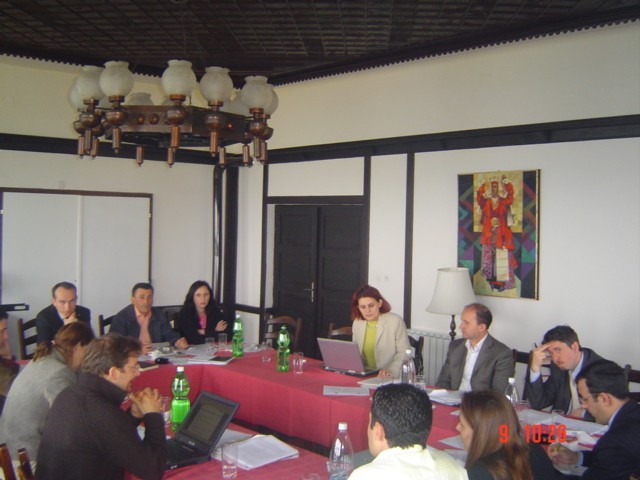
In April 2005, ECMI Kosovo, then the Kosovo office of the European Centre for Minority Issues, brought Kosovo’s political and institutional leaders, the political representatives of Kosovo’s minority communities, UNMIK and the OSCE together at St. Naum on Lake Ohrid for three full days of drafting. Their task was one of the most sensitive in post-war Kosovo: to write the rules on how Kosovo’s languages would be used in public life.
The discussions were intense and often difficult. Every provision touched on identity, dignity and the daily experience of people dealing with their institutions: the language of laws and Assembly proceedings, of municipal services, courts, documents, signs and public information. The work was led by ECMI’s international legal expert Zdenka Machnyikova, one of Europe’s leading specialists on minority language rights, together with Adrian Zeqiri, then ECMI’s Country Representative for Kosovo.
By the end of the third day, the participants had produced and agreed a full draft law. The Assembly of Kosovo adopted the law with only minor changes. It was promulgated as Law No. 02/L-37 on the Use of Languages in October 2006.
The law gave Kosovo one of the most comprehensive language-rights frameworks in the region. Albanian and Serbian became official languages with equal status in all Kosovo institutions. Turkish, Bosnian and Roma can become official languages or languages in official use at municipal level where communities live, and all laws are also published in Bosnian and Turkish. The law created the Office of the Language Commissioner to oversee compliance. Its core principles were later carried into the Constitution.
For the organisation, St. Naum was the beginning of a commitment that has lasted twenty years. ECMI went on to help establish the Office of the Language Commissioner, monitored the implementation of the law, reviewed the consistency of Kosovo’s legislation in both official languages, and trained municipal officials in Albanian and Serbian. The law written at St. Naum remains the foundation of that work.